
Client Background
The manufacturing facility required a fully automated packaging line to improve efficiency, minimize human handling, and maintain strict hygiene standards. The main objective was to automate the movement, sealing, and quality checking of packed products.
Challenges
1. Space Constraints
The available floor space was limited, requiring careful planning to install all equipment without disrupting the workflow.
Ensuring smooth transport of products between machines without bottlenecks was critical.
2. Equipment Synchronization
Integrating the conveyors, sealing machines, and inspection stations into one seamless operation was a major technical challenge.
Slight speed mismatches between conveyor sections could cause jams or misaligned packages.
3. Packaging Consistency
It was necessary to ensure every package was properly sealed without manual intervention, especially with variations in box size and weight.
4. System Maintenance
Given the high automation level, quick access to all machines for cleaning, repair, or emergency stops was mandatory.
The pneumatic and vacuum systems added complexity to the maintenance routines.
5. Workplace Safety
Workers had to interact minimally but safely with the system, particularly near moving parts and high-speed sealing units.
Solutions
1. Optimized Layout Design
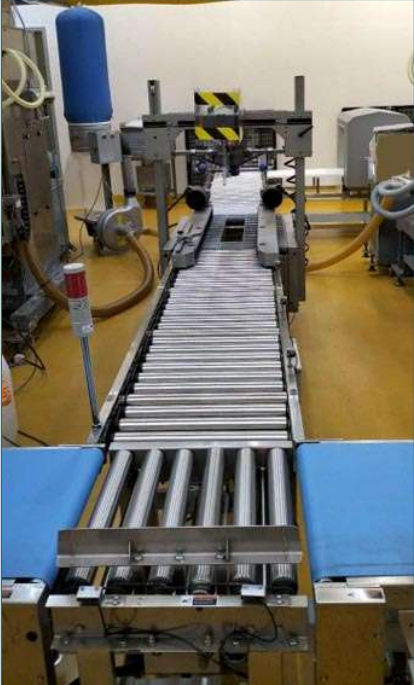
A compact but linear layout was created, using modular conveyor sections to maximize space efficiency.
Key machines like the carton sealer were centrally located for accessibility.
2. Advanced Synchronization Technology
Programmable Logic Controllers (PLCs) were installed to control the speed and timing of each conveyor and sealer.
Sensors were integrated to detect product positions and automatically adjust equipment speeds to prevent jams.
3. Adaptive Packaging Mechanisms
The carton sealing unit was upgraded with adjustable heads to handle different box dimensions.
A quality control checkpoint was added after the sealer to reject any improperly sealed cartons
4. Accessible Maintenance Features
Equipment was installed with hinged covers, quick-disconnect air hoses, and modular electronic panels to facilitate fast maintenance.
5. Enhanced Safety Systems
Staff received additional training focused on machine safety protocols and emergency handling.
Results
30% Increase in Line Efficiency: Faster product throughput with fewer stoppages.
50% Reduction in Packaging Defects: Thanks to better sealing and inspection systems.
40% Faster Maintenance Operations: Less downtime due to easier access and predictive alerts.
Conclusion
The challenges faced during the packaging line setup were successfully addressed through smart engineering, technology integration, and
operator training. The project highlights the importance of anticipating operational challenges and proactively designing solutions, setting a
benchmark for future facility upgrades.